gamescom & devcom 2025: Moving beyond AI buzzwords and back into making great games!
Ennio
Another epic gamescom is in the books and our own Ennio was there and at devcom, where he gave a talk about GARP and the underlying technology we are refining for use in our first game. Following is a recap of his observations from his time in Cologne.
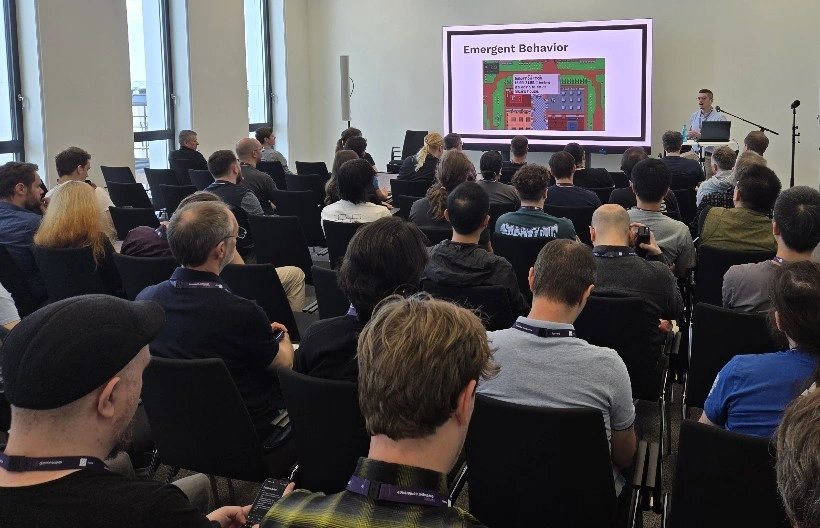
(photo credit: Russell — thanks for permission to use)
It seems the conversation around generative AI in games has finally started to mature. For years, generative AI has been a buzzword that some publishers and platforms have used to monetize visions of a glittering future. Today, it’s clear developers are savvier and can spot the difference between overhyped marketing and genuinely interesting technology.
Of course, skepticism is still there. Many developers openly roll their eyes at the mere mention of “AI.” Others dismiss it as “just a tool,” only considering it for its production uses and not for gameplay at runtime. However, I talked with a growing cohort of developers who are genuinely enthusiastic about its potential to build new types of experiences.
At devcom, I found the most refreshing perspective came from Tommy Thompson, Founder of AI and Games and a veteran with two decades of AI experience. His talk, A Hype-Free Assessment of AI in the 2025 Games Industry, hit exactly the right notes. He argued that we need to shift the conversation away from vague promises (or dystopian fears) about what AI could be, and focus instead on the concrete innovations happening right now.
Equally important, devcom talks encouraged developers to confront issues such as bias, responsible deployment, and the impact of AI on user experience. These are not side conversations anymore: ethical use of AI and clear policies for studios are vital to shape a sustainable and trusted future for this technology. Some notable talks:
- AI in the Game Industry: Algorithm and Blues - Celia Hodent discussed the ethical implications of using generative AI
- What to expect from the European AI Act, the Practical Way - Two researchers from Inholland University discussed the European AI Act and its pillars (Law, Ethics and Robust)
- AI for Accessibility: Adding Real-Time Audio Description to Games using Gen AI - Another practical talk by Xiaochun Zhang (lecturer at UCL) and Thomas Keane (Meaning Machine, another interesting studio making very interesting AI-Native games).
And yet, the industry still has some catching up to do. After my talk, I spoke with developers who were surprised to discover that on-device LLMs are already possible. The general assumption is still that AI must live in the cloud, but that’s no longer true.
Generative Gameplay Appears on the Floor
At gamescom, I was thrilled to see a project that goes beyond AI as a development tool and actually leverages it for gameplay. The Oversight Bureau is a game where characters’ dialogue and voices are generated by AI in real time, letting them respond dynamically to anything a player says. It’s a glimpse of what true generative gameplay can look like when AI isn’t just a production helper, but part of the game’s DNA.
I’m convinced that we will see more AI-Native games being announced in the next months, especially considering how many independent game developers are emerging from the ashes of the wild fires of layoffs that we keep seeing.
Indies Are Rising
One of the most energizing parts of gamescom was the Indie area, which felt bigger and bolder than ever. It was packed with projects full of originality and weirdness, an encouraging sign that fresh ideas are coming back strong. I cannot help but wonder what this crowd of immensely creative and daring developers could create with our AI Engine.
Among my highlights: Beyond These Stars and Dark Switch, two city-builders/sim games with a great personality and interesting twists from the classic game mechanics of the genre.
MÖRK BORG Heresy Supreme, a 2D action RPG set in the MÖRK BORG universe, one of the most interesting tabletop RPGs published in recent years.
Nice Day for Fishing, Viva La Dirt League absolutely nailed this one, full of humor and characters made famous by their web series, a great example of transmedia!
Moving to a completely different genre: Denshattack! certainly stood out, a weird mix of Tony Hawk’s, Japanese megarobots and Subway Surfer…sign me up!
PVKK is my last pick in this very short and not comprehensive list of games that made me want to sitdown and spend my day at the show just playing them. In short, it’s a “Life-in-a-bunker simulator,” where you have to operate and maintain a planetary defence system while uncovering a political plot and solving escape room-like puzzles. Another of those games that immediately sparks my imagination with all the things our AI Engine could add to this type of gameplay.
This is just a very small selection, there were hundreds of indie games, and publishers seem to be waking up, too. After a decade (maybe more?) of rinse-and-repeat franchises, the appetite for risk-taking is returning. I spoke to three major publishers who openly said they are planning to lean into AI-Native games and greenlight projects that are bolder, stranger, and more innovative. If that attitude sticks, it could unlock an era of creativity we haven’t experienced since the early 2000s.
Paradox of a “Struggling” Industry
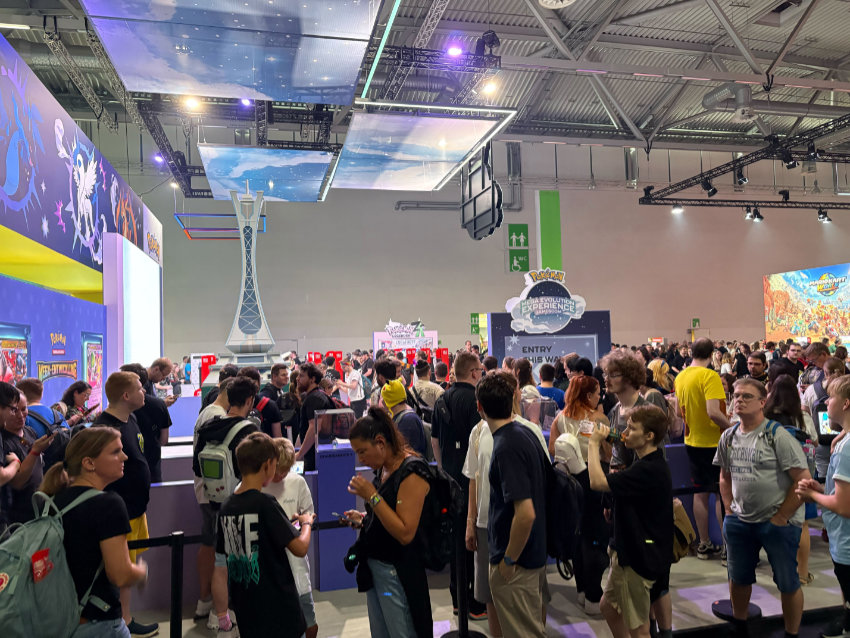
Walking through the immense halls of gamescom, you’d never know the games industry is supposedly in crisis. The energy was electric: hundreds of thousands of players swarmed every booth, from niche indies to blockbuster giants. Two full floors of business space were buzzing with meetings, partnerships, and pitches. The paradox is clear: the audience is bigger than ever, yet so many studios and publishers are struggling. We personally know too many great people affected by recent layoffs and hope the new energy coming from publishers soon results in a return to work for affected people. For those out there experiencing issues on the job front: check out Amir Satvat’s amazing community.
Fantasy Is Back (Again)
If there was one visual theme that dominated this year, it was medieval fantasy. Countless booths looked like castles, taverns, or medieval villages. Blizzard’s new World of Warcraft expansion announcement certainly helped, with their booth radiating pure nostalgic vibes. But they weren’t alone:
- Crimson Desert and Anno 117: Pax Romana had jaw-dropping themed booths (Anno wasn’t exactly medieval fantasy, but its Ancient Rome historical setting contributed to the vibe!).
- Smaller productions tapped into history and fantasy too, like the Gothic remake, God Save Birmingham, 1348 Ex Voto, Norse: Oath of Blood, Regions of Ruin, The Blood of Dawnwalker, and even a surreal Hieronymus Bosch-inspired title.
Clearly, the fascination with epic medieval and ancient history worlds is alive and well, and I am grateful to the game developers that keep this fantasy alive and to all the players who keep losing themselves in those worlds!
Other Trends That Stood Out
- Resident Evil Requiem: The line for Capcom’s booth on industry-only day (Wednesday) was absolutely wild, in stark contrast to the many nearby booths that stood empty. Hype still matters.
- Steam Wishlists: Indie devs kept repeating the same mantra: wishlists are everything. Discoverability remains the number one problem, for small and large studios alike.
- Roguelikes Everywhere: The roguelike loop is now the default design template. Even Ron Gilbert is joining in with his new game, Death by Scrolling.
- Influencers on the Floor: Industry day was packed with influencers filming TikToks and Instagram content. At times, I felt a bit disconnected from the world these people were in, but it’s a stark reminder that our industry has evolved way beyond what older generations of game developers know. And it is something to always keep in mind: hundreds of millions of players belong to that world.
Looking Forward
Gamescom 2025 left me optimistic. AI is no longer just a buzzword and is beginning to deliver genuine innovation, while indies are showing us what originality looks like again. Publishers, meanwhile, seem ready to take risks after years of sticking to formulas.
The halls were crowded, the energy was contagious, and the appetite for games of all kinds was very much alive.
If this year is any indication, the next wave of game development will not be about repeating the past but about finally embracing what’s possible: ethically, creatively, and technologically.